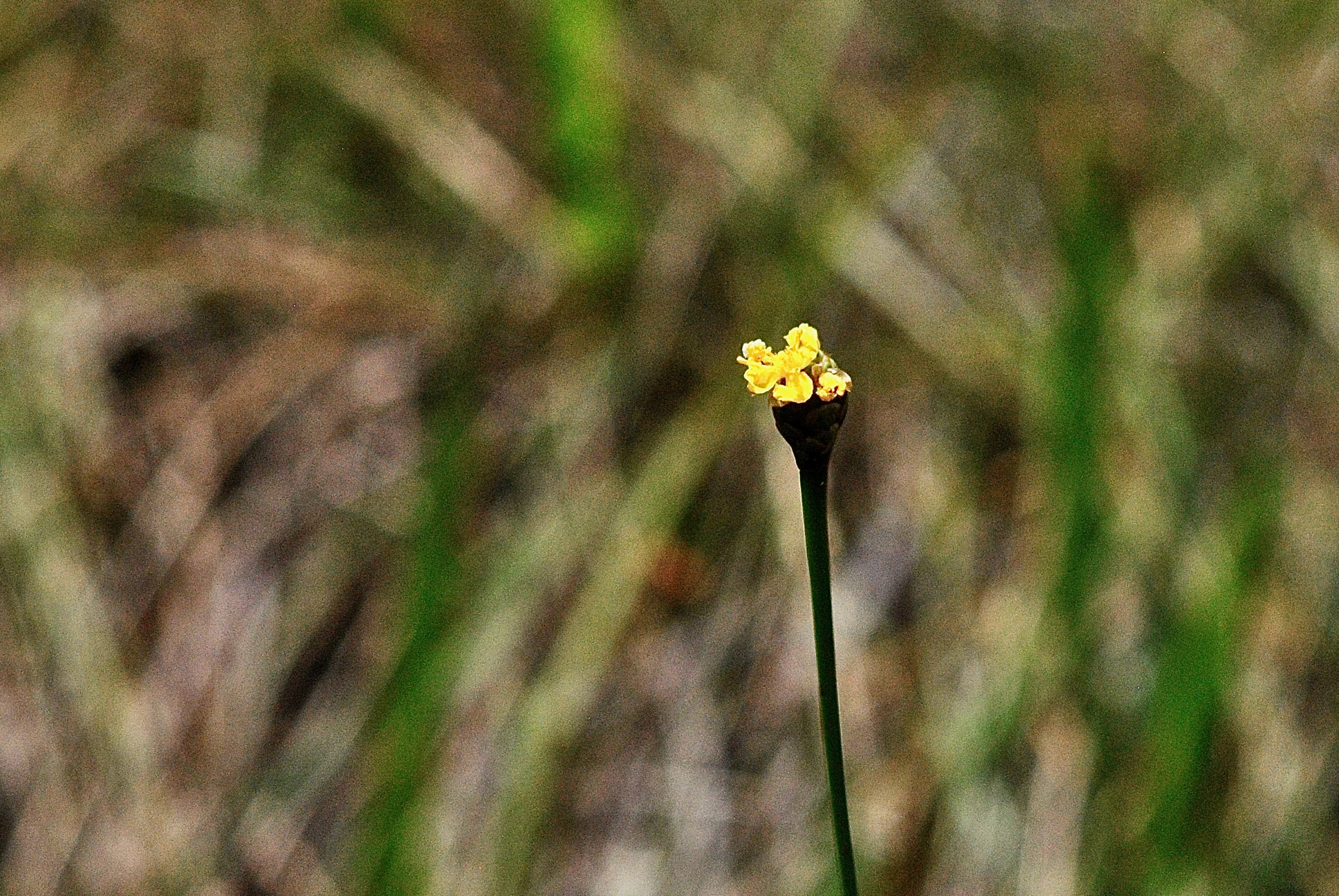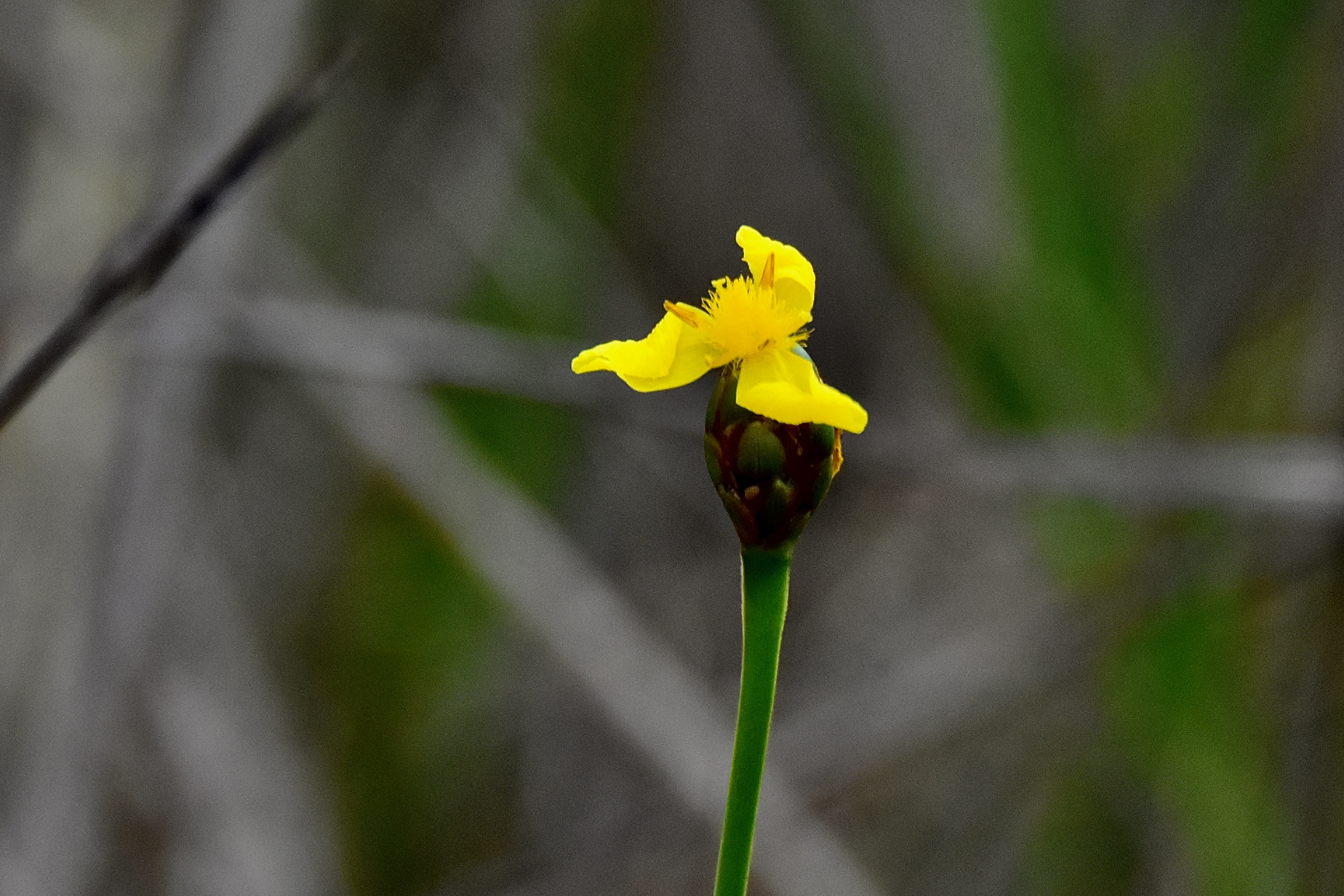
Richard's yellow-eyed grass, photographed along the Apoxee Trail, West Palm Beach, Palm Beach County, in April 2018.
Hike through the wetlands that dot South Florida and almost certainly you’ll come across a plant with a small bright-yellow tri-petal flower sitting atop a tall, thin stalk.
Not an iris. Not a lily. No, you’re looking at a member of the Xyris genus of plants, a yellow-eyed grass.
And chances are pretty good that it’s this guy, Richard’s (pronounced REE SHARD’S) yellow-eyed grass, Xyris jupicai.
Yellow-eyed grasses are commonly found in places with wet soil — marshes, wet prairies, swamps, savannas, flatwoods and their margins. They can be found along roadsides or trailsides in places that remain wet or damp a good portion of the year.
There are 25 accepted taxa — species or subspecies — of yellow-eyed grasses in Florida, of which 11 are found in South Florida. Representatives of Xyris can be found in all 67 counties.
Of the 11 yellow-eyed grasses found here, all but one — Richard’s — are either rare or imperiled within South Florida, as rated by the Delray Beach-based Institute for Regional Conservation. Most, perhaps all, are native to Florida. The one that might be an exception is the aforementioned Richard’s. Most sources, including the Atlas of Florida Plants, give a thumbs up to native status, but the Institute for Regional Conservation says thumbs down. As did the late Florida Atlantic University botany professor Daniel Austin. So flip a coin.
The standard definition of a native is any plant present at the time the first Europeans set foot on our shores.
Richard’s yellow-eyed grass is a perennial, relatively tall, compact plant capable of colonizing disturbed or open wetlands. It likes sandy, alkaline soils. Quick note: The Flora of North America says Richard's is an annual, while the IRC says perennial. The difference might be due to geography and South Florida's year-round warm temperatures.
It is an upright plant, with long, smooth, grass-like leaves that are arranged in ranks of two alternately along the stem. The scape, or flower stalk, is papillate, or in plain English covered in minute bumps.
Richard’s blooms throughout the year in South Florida, spring through fall farther north. The flowers are bright yellow, about a quarter- to half-inch across with three petals. They sit atop a long, thin scape as part of a “cluster” that looks to us like a pineapple. (To Austin, it looked like a pine cone.)
Richard’s can reach three feet tall.
Richard’s yellow-eyed grass is found in all Sunshine State counties except Union and Suwanee. It’s also absent from the Keys.
Beyond our borders, Richard’s yellow-eyed grass ranges throughout the Southeast as far north as Virginia and as far west as Texas. It also can be found in Illinois and Missouri.
Its native range extends south through the Caribbean, Mexico, Central America and South America as far as Uruguay.
There are two other yellow-eyed grasses that are similar in looks to Richard’s, Florida yellow-eyed grass, Xyris difformis var. difformis, and Irisleaf yellow-eyed grass, Xyris laxifolia. Florida yellow-eyed grass is rare in South Florida, irisleaf not at all, per the IRC.
Some notes generally on yellow-eyed grasses: worldwide there are more than 250 species found in the Americas, Africa, Asia and parts of the South Pacific, according the Flora of North America. FNA has listings for 21 species within its pages. The U.S. Department of Agriculture’s PLANTS Database lists 32 taxa, including species and subspecies.
All but one of the 32 are native to the eastern United States and Canada; a few range across the Mississippi as well, but none is found west of the Great Plains, according to the PLANTS Database. Interestingly we did find one that only calls Hawaii home.
It’s relatively easy to identify a yellow-eyed grass, but sussing individual species, well, that can be difficult. (We relied on iNaturalist and additional research sources to ID the plants on this page as Richard’s.) The Flora of North America does offer key/guide that helps.
The same FNA page notes that several regions within South America are particular hotspots for yellow-eyed grasses. The native range of many Xyris species, including Richard’s, includes these places.
Austin, the late FAU botany professor, in his manual on wetland plants, noted that some South American species can be giants relative to what we see in the U.S. On the Kaieteur Plateau of Guyana, there are yellow-eyed grasses with leaves three feet long or more, and scapes even longer. Austin speculated that our varieties, most of which are measured in inches rather than feet, might be smaller as an adaptation to cooler weather.
The French naturalist Louis Claude Marie Richard, who explored the flora of Central America and the Caribbean during the 1780s, was the first to scientifically describe his namesake yellow-eyed grass. Richard was an important enough figure that he had a genus named after him, Richardia. (There's a fair chance that at least one member of the genera is present in your lawn in the form of Mexican clover, aka Florida snow.)
Richard’s yellow-eyed grass is used in traditional medicine in places as a treatment skin conditions like eczema and leprosy. It is grown for medicinal uses and for water gardens in some place.
Jupicai stems from a Guarani word meaning “frequent in wet places.” Guarani is a language spoke by the indigenous people of Paraguay. It’s also one of that country’s two official languages. Spanish is the other.
We’ve seen two explanations for Xyris: A) it is from the Greek word Xyron meaning “razor,” a reference to the “sharp,” two-edged leaves; B) Austin said it’s from the Greek Xyros, meaning “loving dry places.” Take your pick.
Other common names for yellow-eyed grasses: hardheads, a reference to the flower clusters that sit atop these plants. Yellow-eyed grass is also spelled yelloweyed. Richard’s yellow-eyed grass is a member of Xyridaceae, the family of yellow-eyed grasses.
Photo Gallery — Click on photo for larger image