
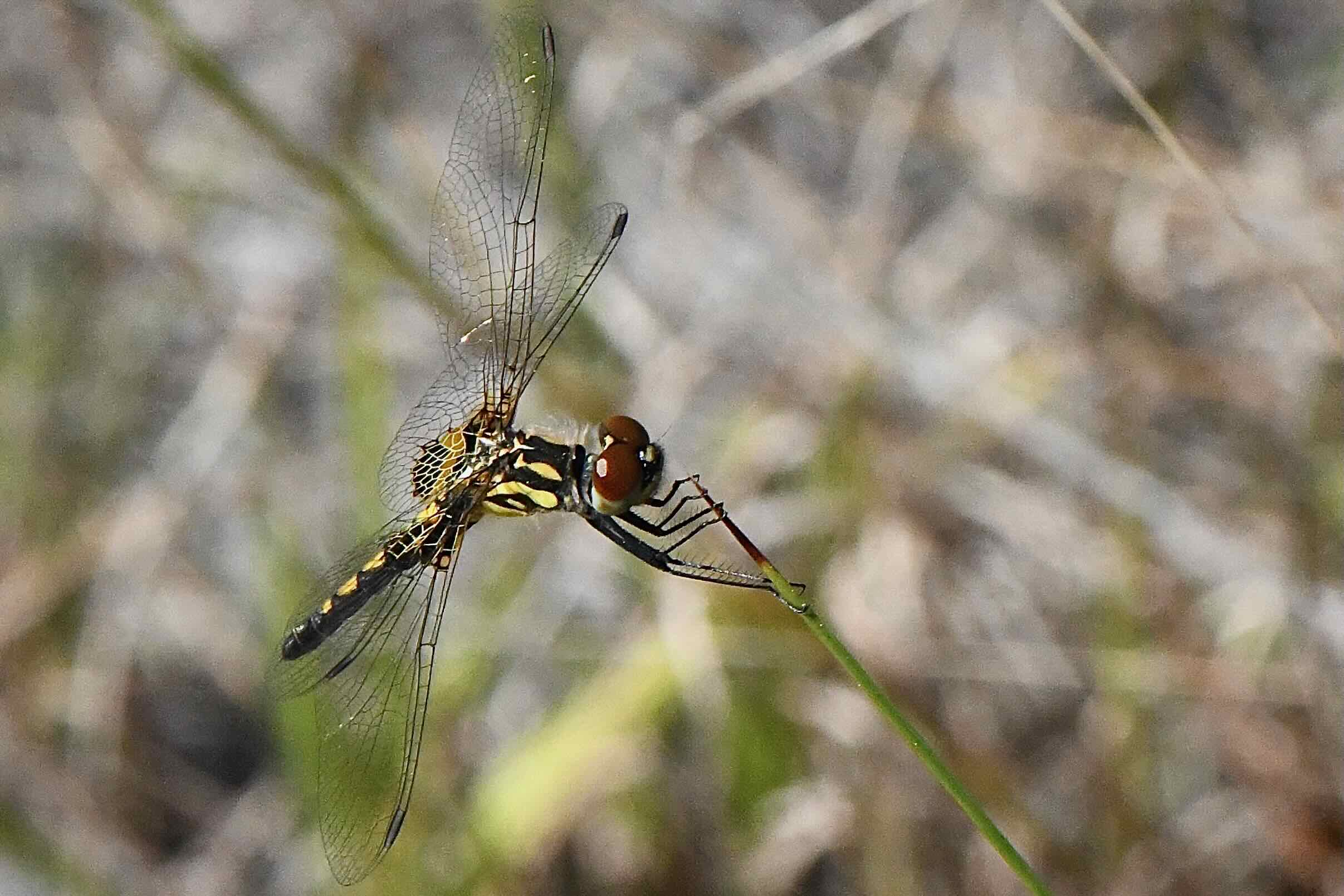
Ornate pennant dragonfly, photographed at Loxahatchee Slough Natural Area, Palm Beach Gardens, Palm Beach County, in February 2025.
Ornate indeed. Your first glance at Celithemis ornata and the common name, ornate pennant dragonfly instantly makes sense.
They range in color from the bright yellows seen in the photo above to intricate reds and oranges. Pennant, you might ask? They tend to perch atop tall, open vegetation, a reed, a sedge, a blade of grass in flag-like fashion.
Ornate pennant dragonflies are cousins of the Halloween pennant dragonfly, arguably the most common dragonfly found in the wilds of South Florida. They’re not nearly as common as the Halloween pennant and smaller, topping out at 1.4 inches in length.
But like their cousins, ornate pennants are most likely to be found near bodies of fresh water, a lake, a pond, a marsh, water bordered by dense vegetation. Like all dragonflies, they begin life in water.
The ornate pennant is one of eight members of the genus Celithemis, all of which have the habit of hanging out like a flag. The name is a mashup of two Greek words, keli or celi, meaning abdomen, and themis meaning what has been established. Themis is also the Greek goddess of order and justice. Themis, according to BugGuide, also could derive from the suffix hemis or emis, meaning half.
Ornates are similar to the Amanda pennant dragonfly. The tell: look at the markings on the hind wings. On the ornate, they only extend part way along the width of the wings; on Amanda, they extend the full width.
Females and young males sport the yellow look seen in the photo above. As the males mature, a chemical process takes place turning them more of a dark red or dark orange.
There are several reasons for the change. For one, dragonflies have outstanding vision, their other senses, hearing, smell, not so much. The change in colors makes it easier for males and females to find each other.
According to researcher Ryo Futahashi of Japan’s National Institute of Advanced Industrial Science and Technology, for young males, sporting the yellow is an advantage. The look tells mature males that these are youngsters and aren’t yet a mating threat. This allows young guys to avoid territorial fights. The chemical change also might provide them with a degree of UV protection.
To be clear, this metamorphosis of sorts isn’t unique to ornate pennants. Other dragonfly species have different color schemes for males and females and different looks for immature and mature males.
A couple of quick notes: Our guy was known as the faded pennant until the Dragonfly Society of America decided ornate pennant was more fitting. The International Union for Conservation of Nature rates the ornate pennant a least concern on its survival scale.
Jules Pierre Rambur, a 19th century French entomologist and expert on dragonflies scientifically described the ornate pennant in 1842. It is a member of Libellulidae, the family of skimmer dragonflies.
Loxahatchee Slough Natural Area