
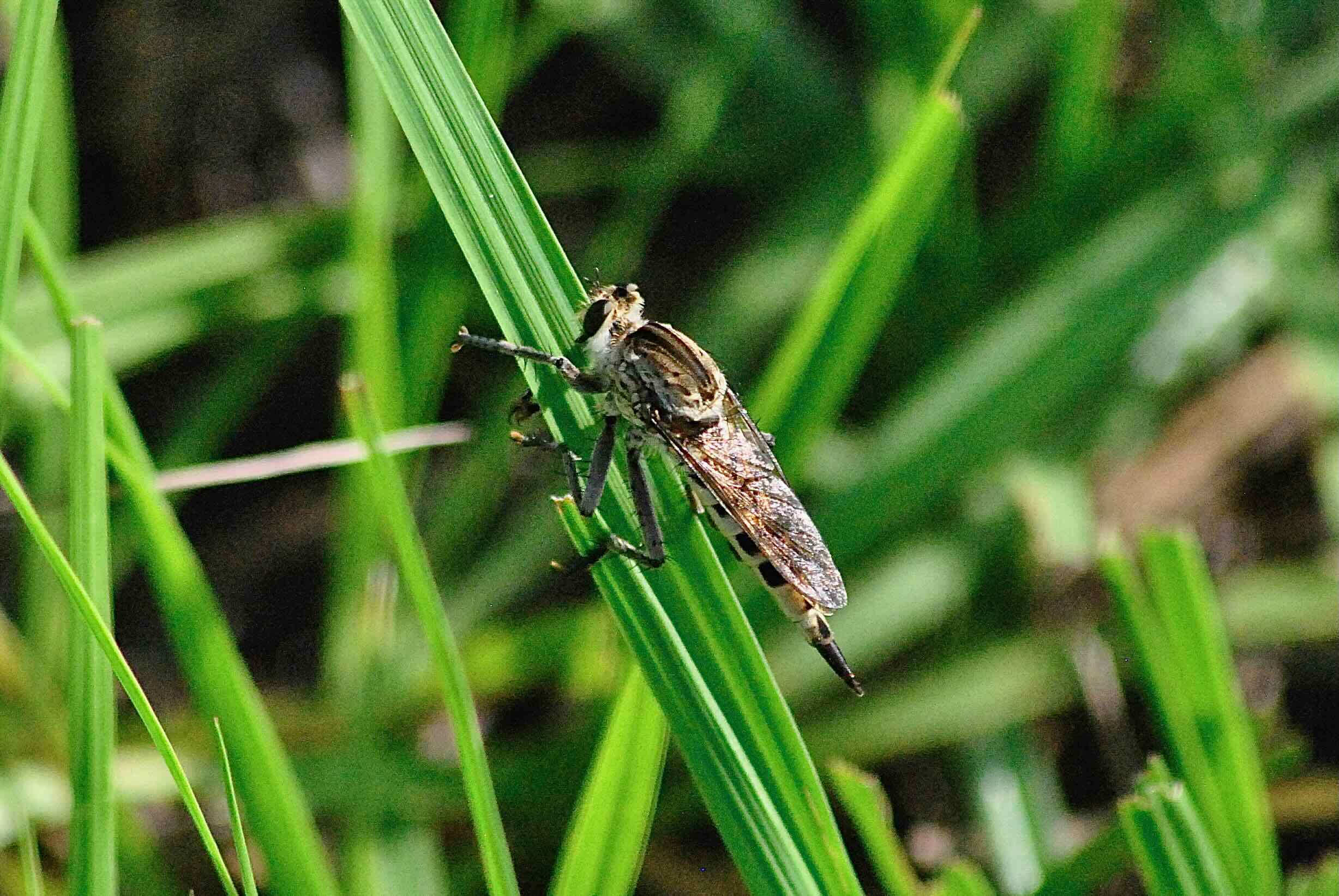
Northern triorla robber fly, photographed at the Allapattah Flats Wildlife Management Area, Palm City, Martin County, in September 2015.
For entomologists, the scientists who study and classify insects, the size of various body parts certainly matters, but so does their shape and structure. In fact, it can matter a whole lot.
Case in point the Triorla genus of robber flies and one of the most common robber flies found in Florida: the northern triorla, aka Triorla interrupta.
Entomologists have used various body parts to slice and dice the world’s insect population into various taxonomic classifications at least since the 18th century and the great Swedish naturalist Carl Linnaeus.
It might see a bit odd, but in the 1960s, a university researcher examined the male “junk” of our subject and determined that it sufficiently different from other robber flies so it should be classified as a member a new genus. That’s a bit of an oversimplification, the nickel version of the story, but it illustrates our point.
More on this in a bit. First, a little about robber flies generally and the northern triorla specifically.
When we think of flies, the first thing that comes to mind for most of us are the buzzing bugs that bug us during a picnic: the fruit fly. Robber flies have as much in common with these pests as house cats have to tigers. They are large and aggressive predators, willing to take on insects and spiders their size or larger. Wasps, bees, grasshoppers and dragonflies are on their menu. They’ve been known to go after small birds on occasion.
Their larvae (aka maggots) are predators as well. In the case of the northern triorla, the larvae among other things feed on certain white grubs of the sugarcane beetle. So much so, that our guy has been considered economically important in a positive way.
Northern triorla robber flies are half-inch or more in length. They are primarily gray with hints of brown, especially on the thorax. The abdomen, the third body segment, is marked with a series of distinctive dark dashes, as seen in the photo above.
Their range includes much of the United States roughly south of a line drawn between North Carolina and Kansas, and from Florida to Texas, west again to California. Mexico, Central America and portions of Colombia are also part of their range.
Northern triorlas tend to like open, grassy areas, which is one of the reasons why they’re among the more commonly spotted robber flies in the U.S., Florida included.
Way back in 1834, a French entomologist and Diptera (flies) expert named Pierre-Justin-Marie Macquart was the first to scientifically describe the northern triorla. He named it Asilus interruptus.
Over the decades, our guy shuffled between four different genera. That is until an Oregon State University scientist named LeRoy Parks came along. In a paper published in the July 1968 issue of Pan-Pacific Entomology, Parks determined that the bug that Macquart first described 130 years earlier should be placed in a new genera he called Triorla. Parks also placed another robber fly now known as T. striola, into the classification.
One of the defining feature of the new classification: “The genus Triorla has three long apical aedeagal tubes which separates it from Efferia … with a hook-shaped aedeagus, and from Eicherax … whose aedeagus has three short apical tubes,” Parks wrote.
The aedeagus is the male’s sexual organ; Efferia and Eicherax are two robber fly genera in which the northern triorla once was assigned. The genus name, Triorla, is believed to be a reference to the three aedeagal tubes.
Unfortunately, Parks died in 1966, just before completing his paper; OSU Professor Charles Martin, who aided Parks in the research, edited Parks’ work and had it published.
In the decades since, Triola has grown to 14 species. The northern triorla is the only member found in North America, which we’re assuming is the reason behind its common name.
More on robber flies. The northern triorla is one of the 7,003 species of robber flies in the world that have been identified and described as of this writing (August 2025). They’re found on every continent sans Antarctica, as you might expect. There are 1,000 species found in the United States.
And it’s one of 111 robber fly species to be found within the bounds Florida (there are 17 additional species believed to be here but their presence is yet unverified).
Robber flies take their prey in flight, clutching their target with spine-laden legs. Once secured, they’ll use their knife-like proboscis to inject their prey with a saliva that’s a mix of neurotoxins that paralyze their victim and proteolytic (protein dissolving) enzymes that essentially liquify their innards. The robber fly then returns to his roost and enjoys a nice meal of bug-guts soup. Yum!
The life cycle of robber flies can be as short as a year or as long as three. There are theories that the lifespan of robber flies in warmer climes tend to be on the shorter end.
The northern triorla is a member of Asilidae, the family of robber flies.
Allapattah Flats Wildlife Management Area