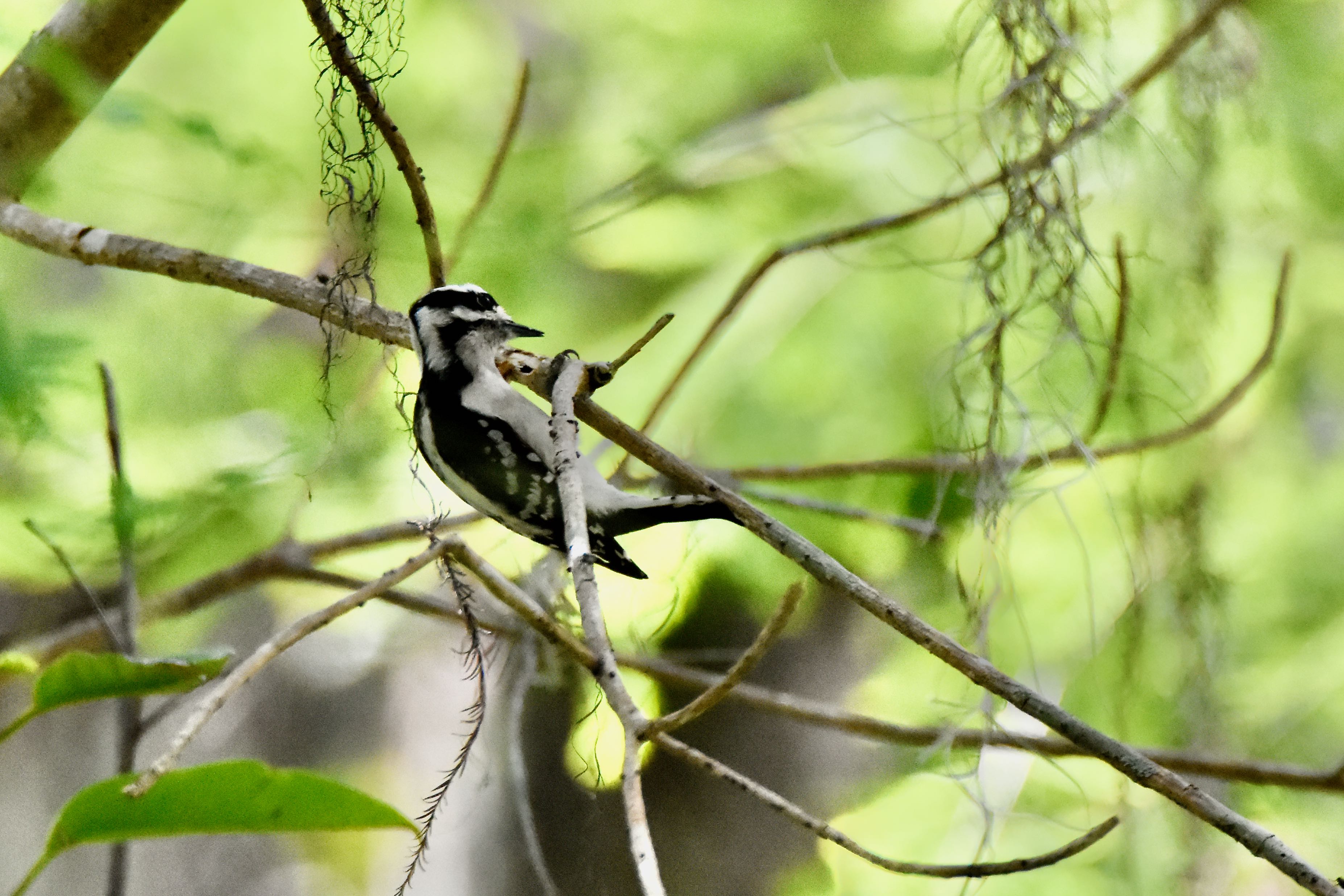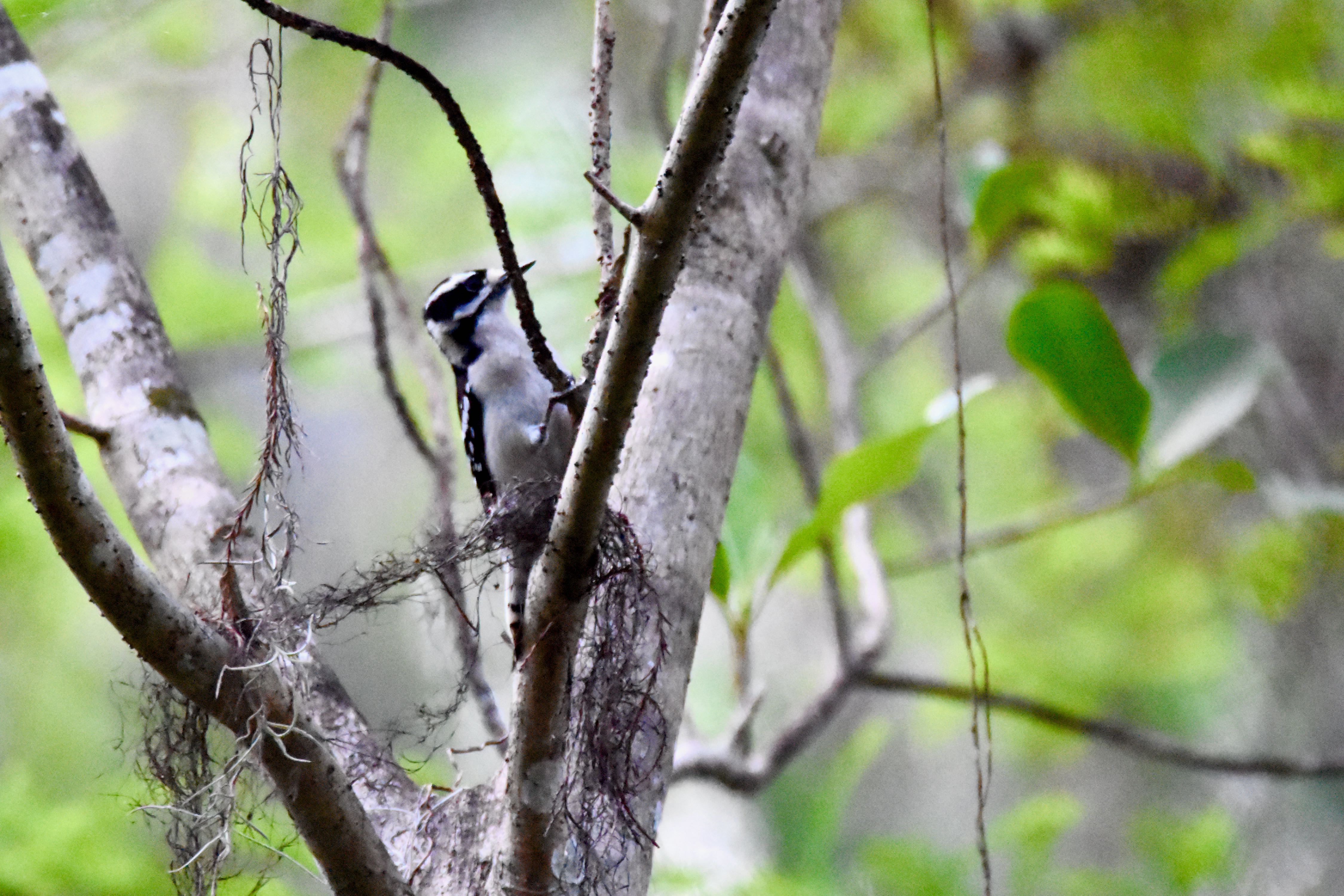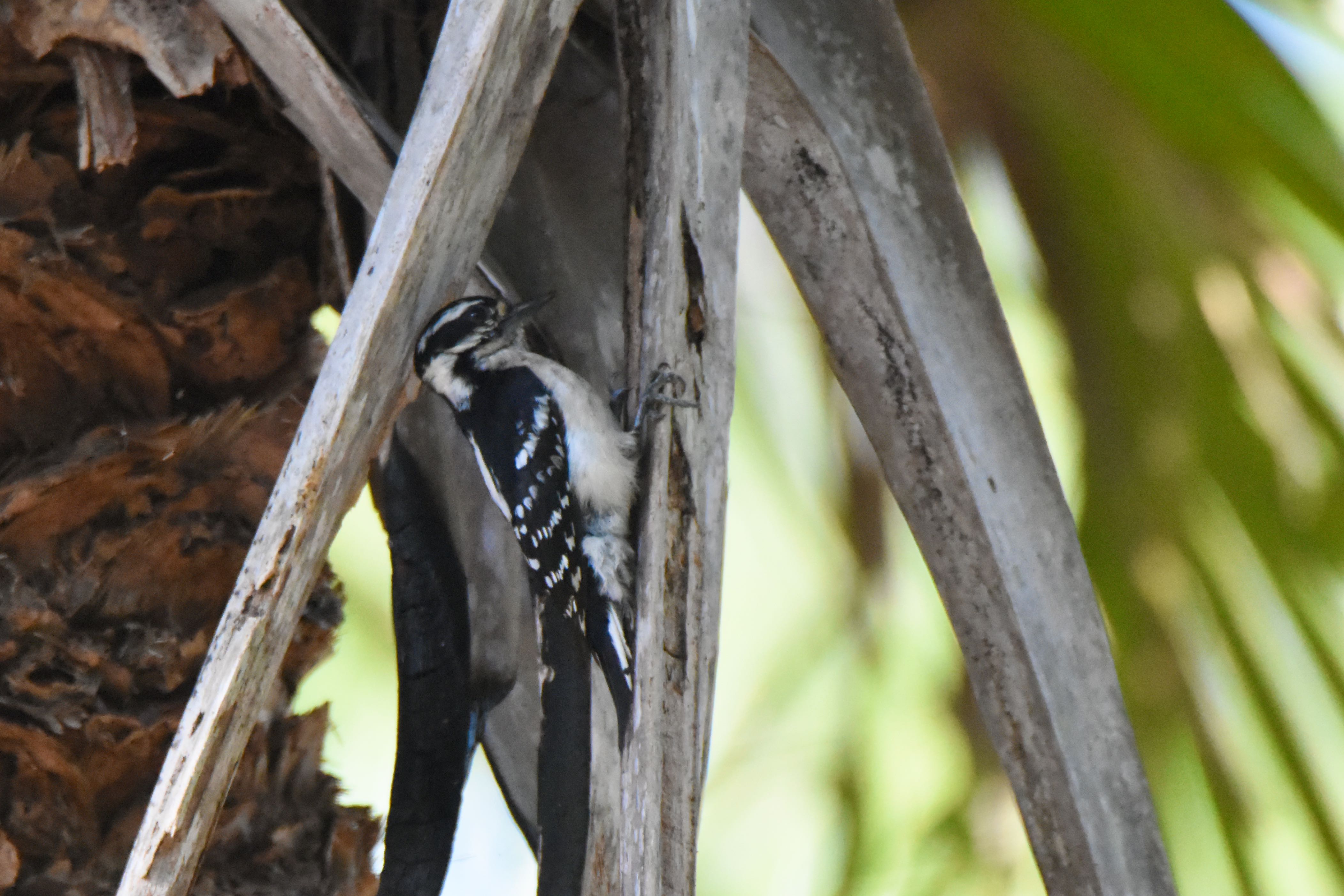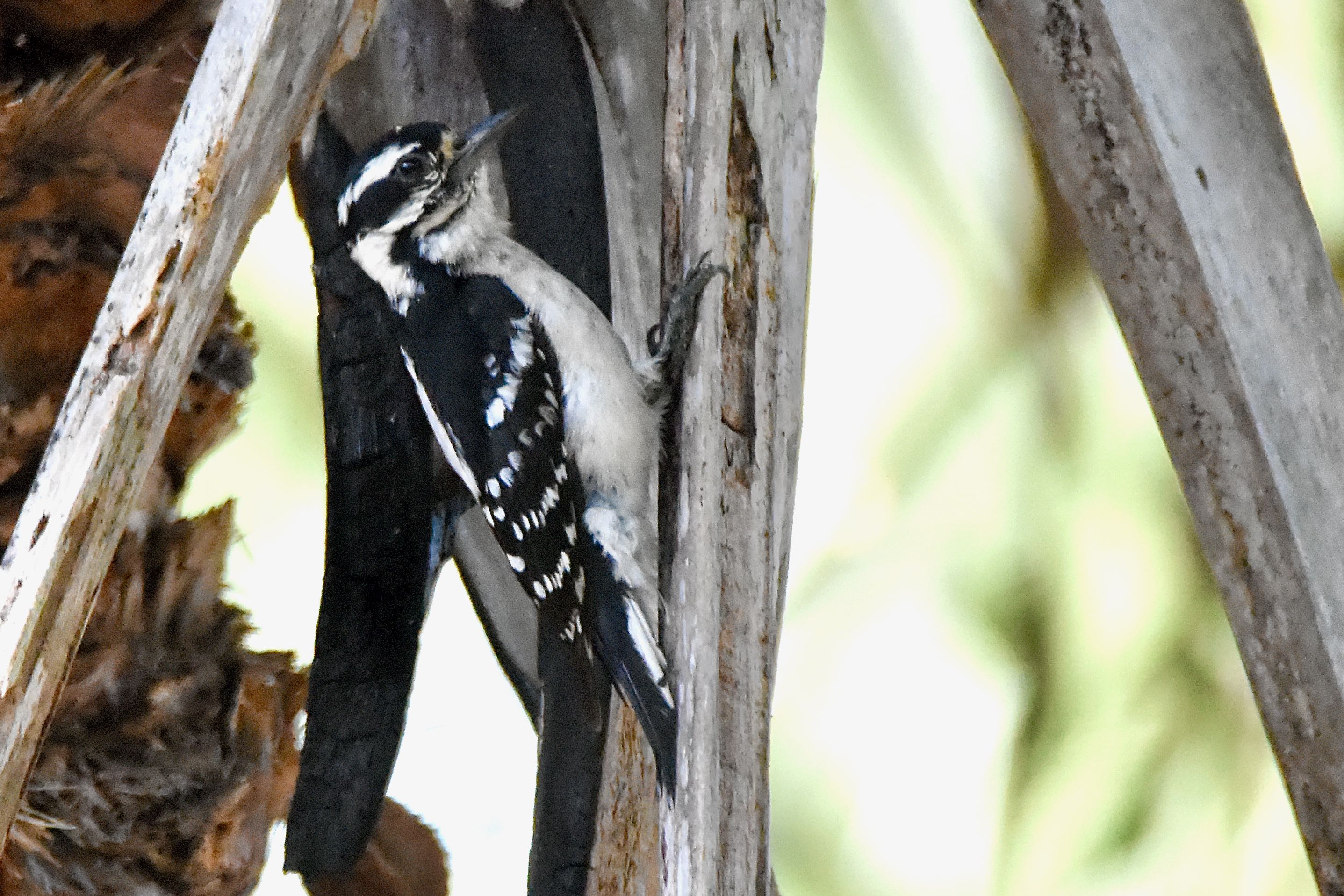
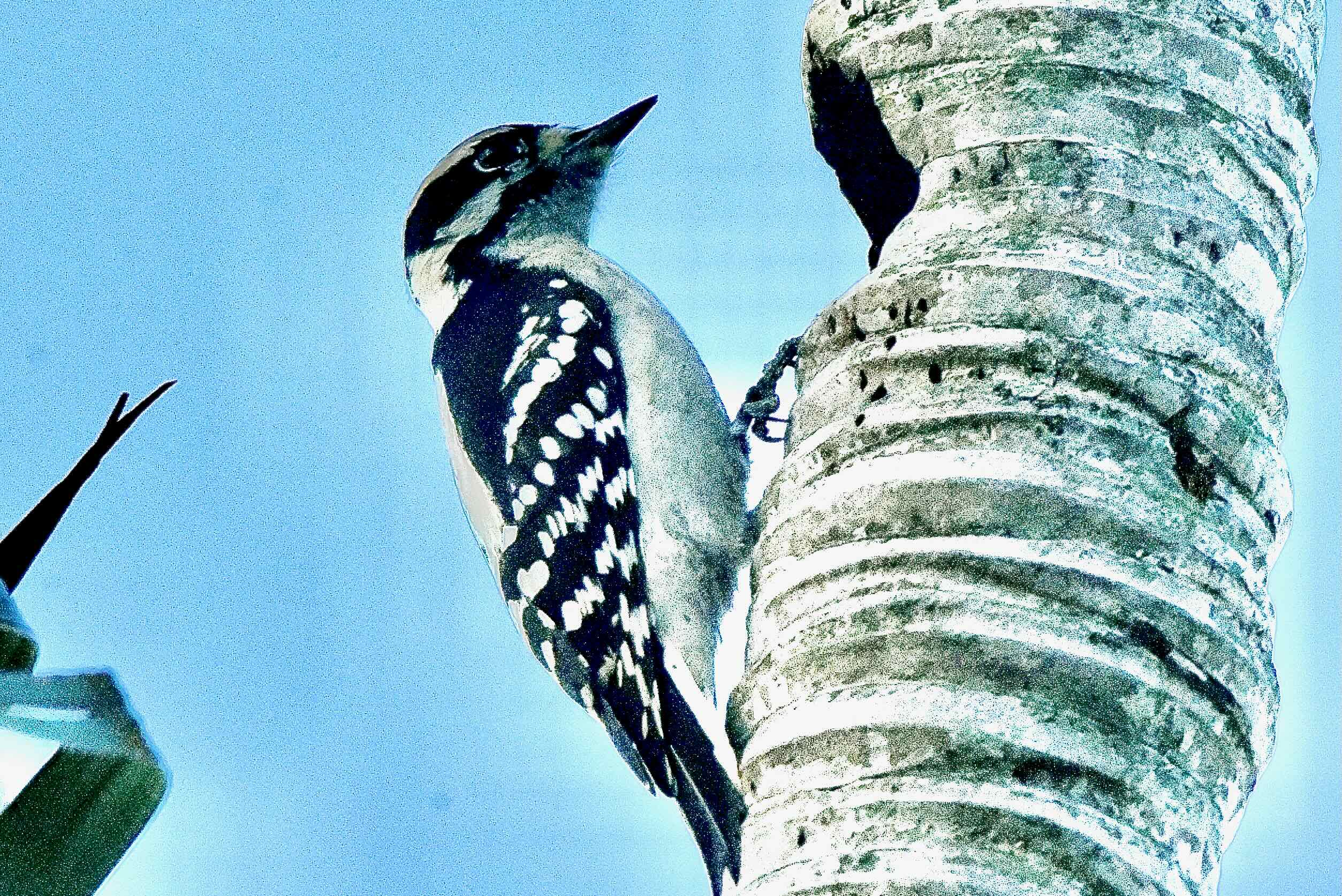
Downy woodpecker, photographed at Frenchman's Forest Natural Area, Palm Beach Gardens, Palm Beach County, in April 2018.
Sometimes there's an advantage to being small. Case in point, the downy woodpecker, Dryobates pubescens.
The downy is about as small as woodpeckers get, the smallest native to North America, but they use their diminutive size to their advantage by foraging on small branches, twigs even, that can't hold their larger cousins. They are so small that they can even clamber onto tall weeds and peck away in their quest for nourishment.
Downy woodpeckers are distinctive in another way: they are one of the least red of all of South Florida's woodpeckers, rivaled by the extremely rare red cockade. Only the male has a small patch of red on the back of his head. Otherwise, they're entirely black and white. They do have the woodpeckers' telltale trait of using their tails as a third landing point when they latch onto the trunk of a tree.
Downy woodpeckers range throughout most of the United States and Canada, as far north as Alaska, the Yukon and the Northwest Territories.They're found throughout Florida. And like most woodpeckers, they're generally year-round residents. Some nonbreeding birds in the northern fringes of their range will head south in winter, but not major distances. These birds can be found in open woods, the 'burbs, parks and orchards and even at a backyard feeder. They prefer hardwood trees that drop their leaves rather than conifers.
Downies are almost entirely black and white, black wings with white spots. They have black bands on their faces, one at the eyes, one at the chisel-like bill, both extending across, then down the back of the head. The back has a broad white stripe; the underside is also white. Body length is less than seven inches; the wingspan is less than a foot.
The looks are similar to the hairy woodpecker, but downies are a third less their size. And hairy woodpeckers might be Florida's rarest woodpeckers. See a woodpecker with this color pattern and it's almost certain to be a downy. Yellow-bellied sapsuckers are also somewhat similar in appearance, but are also much larger, more patterned and tend to have a bit of a yellow hue to them. Male sapsuckers have red throats. along with the red on the back of the head.
Bugs are at the top of its menu, particularly beetles and ants. But downy woodpeckers will eat other insects as well as seeds and berries. Put up a feeder and fill it with suet and you might find a downy nibbling away. They will forage up and down and along the main trunks of trees, small branches, into shrubs and weeds in search of a meal with an acrobatic style that most woodpeckers lack. Downy woodpeckers prefer to nest in hardwoods, chiseling out a hole in a dead tree or a dead limb of a tree, usually far off the ground. Males and females will split into separate feeding territories in late fall or early winter; come late winter, they will begin to drum loudly and males will gradually approach. Both partners excavate the nest cavity.
Downy woodpeckers will have one brood in the northern parts of its range, possibly two down south, having three to eight eggs, which require about 12 days of incubation. Both parents handle sitting duties; both feed their brood. The offspring leave the nest three to four weeks after hatching, and may follow their parents for a time afterwards.
Until 2015, taxonomically speaking, downy woodpeckers carried the binomial, or scientific name, Picodoides pubescens, Picodoides being a mashup of Latin and Greek words meaning "woodpecker-like." English naturalist and illustrator Mark Catesby (of Catesby's lily fame), was the first to describe the downy and included plate illustrations of the bird in his book, The Natural History of Carolina, Florida and the Bahama Islands published between 1729 and 1732. Catesby didn't give the downy a scientific name, or at least one that stuck, because the system of systematic names we use today hadn't been invented yet. The great Swedish naturalist Carl Linnaeus working from Catesby's book named it Picus pubescens. It was Linnaeus, of course, who would invent the naming system we still use today in 1753.
Scientists later moved the downy into Picodoides, a genus of three-toed woodpeckers. In 2015, however, scientists realized that members of Picodoides were different enough from each other that they should be split into different genera, with our friend the downy ending up in Dryobates, which means woodland walker, or tree walker, a fairly descriptive name for the way it forages.
Pubescens, as you might guess, means covered in fine hair, or down. Put it together with Dryobates and you've got a tree-walker covered in down. You will see the old name in some references. Editors and publishers can be slow sometimes in making updates to their pages.
Fun taxonomic fact No. 1: There are seven recognized subspecies of downy woodpeckers. The one most likely to be seen in our part of the world is D.p. var. pubescens. Fun taxonomic fact No. 2: Despite their similar looks, the downy woodpecker and the hairy woodpecker are not closely related.
With that, our final taxonomic note: Downy woodpeckers are members of Picidae, the woodpecker family.
Frenchman's Forest Natural Area
Click on photo for larger image