
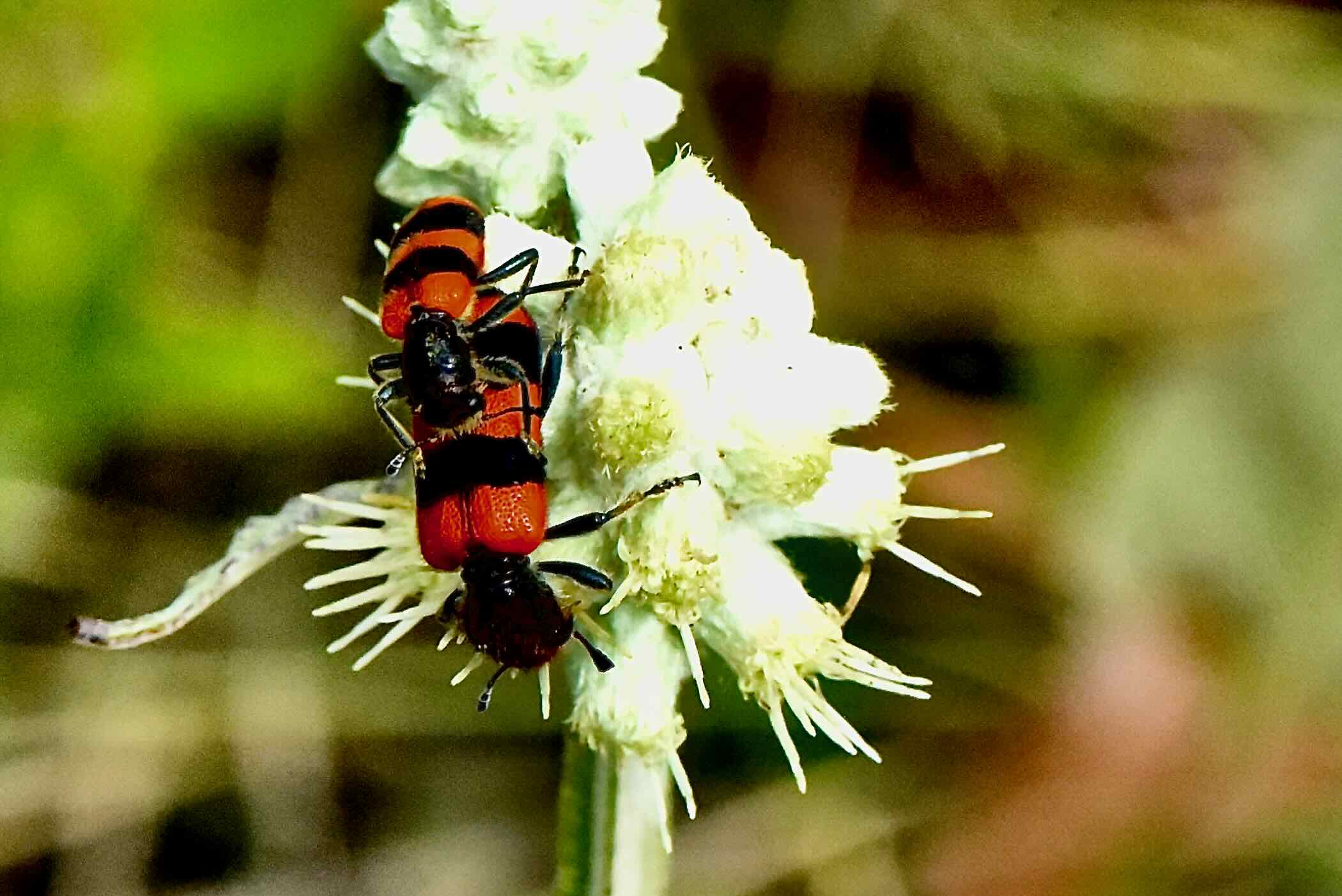
Checkered beetles, photographed at Jonathan Dickinson State Park, Hobe Sound, Martin County, in April 2026.
To most insects, a visit to a Venus flytrap means death. To Trichodes apivorus, it means dinner. Or lunch or breakfast, for that matter.
It’s one of handful of insects that can visit a Venus flytrap, dine on its pollen and live to tell the tale, assuming an insect could, in fact, tell a tale.
Why exactly it escapes death isn’t quite known to scientists. One theory: somehow it’s the color pattern, a combination of bright reds and blacks. Plausible? Maybe. Maybe not.
In any regard those hues are vital, allowing Trichodes apivorus to go about its business with some degree of safety. We explain.
First thing to know is that Trichodes apivorus is a member of a group of insects called checkered beetles. It has no accepted common name. For simplicity sake, when we use checkered beetle, we’re referring to Trichodes apivorus rather than the group as a whole, unless stated otherwise.
The main claim to fame of the checkered beetle seems to be its association with the Venus flytrap. It pollinates the plant, and its ability to do so without getting gobbled tends to grab one’s attention. The Venus flytrap, however, is native only to a small area near Wilmington, N.C. Our checkered beetle isn’t a picky eater, and it ranges far beyond Wilmington. It will dine on the pollen of flowers from at least 10 different families. In the photos on this page, the checkered beetles are, uh, visiting black root, a member of Asteraceae.
Its native range extends along the eastern seaboard as far north as New England and as far south as Florida, with specimens collected in Collier, Martin, Miami-Dade and Palm Beach counties. It’s been found as far west as Nebraska and Texas.
Our guy is a member of Cleridae, the checkered beetle family of which there are 11 North American members. They are all pollen eaters, and like a few other beetle families, play important roles in the natural scheme of things as pollinators.
All 11 have some mix of bright reds, oranges, yellows and blacks. There is no attempt to camouflage themselves, no attempt to blend into the scenery. They simply stand out for all the world to see.
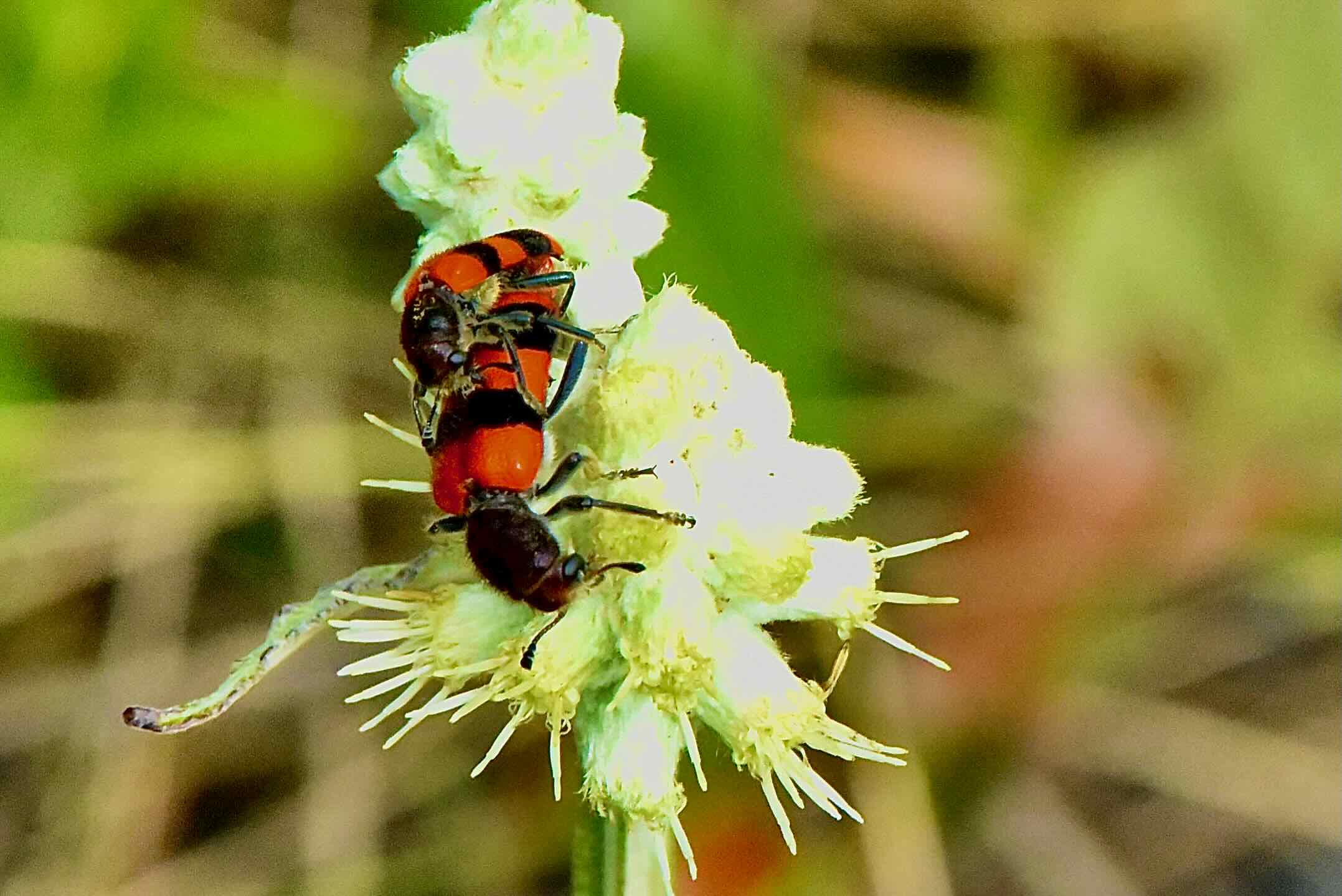
And as we noted earlier, those bright colors keep checkered beetles, our guy and his cousins, safe in a world full of predators.
In the world of science, it’s call aposematic coloration. The bright colors that the checkered beetle and its cousins sport serve as a warning to predators, birds in particular, that eating them might be a deadly mistake. Or at least make them ill to the point where they might wish they were dead. It’s the same defense that monarch butterflies employ.
Members of Cleridae are medium-sized as beetles go, with relatively long, narrow bodies. They go between a quarter and a half inch long. Checkered beetles are on the larger end of that range. Males and females are similar in looks, with three red bands separated by two black. Their bodies are covered in fine hair. In fact, Trichodes means hairy, or covered in hair. They’re typically found in pine forests.
While adult checkered beetles are pollen eaters. the kids enjoy a more meatier diet. They’re also parasites.
It works like this: mom checkered beetle stakes out a spot in a flower likely to be visited by a female solitary bee. To be clear, these are not honey bees or any kind of social bee. Rather, they’re bees that live alone and nest in the ground; females lay their eggs singly in a series of chambers, each stocked with pollen for their offspring to eat as they develop.
The checkered beetle lays an egg in the flower; when it hatches, the larvae will wait for a solitary bee to stop by, grab onto her and hitch a ride to her nest.The larvae will drop off the bee; when the cell is sealed, the beetle larvae will devour the pollen and then bee larvae. It may bore its way into adjoining cells and devour the contents as well.
Checkered beetles develop through various larvae stages, including a fourth when they’ll hibernate, then pupate and emerge as adults. Their life cycle is estimated by some at a year. In Florida, the adults are active spring into late fall.
There are two subspecies of checkered beetles, borealis, found from Georgia into New Hampshire, and apivorus, found in Georgia, Alabama and Florida.
There is some evidence that the population of borealis might be declining, but the overall, the population of checkered beetles appears to be secure.