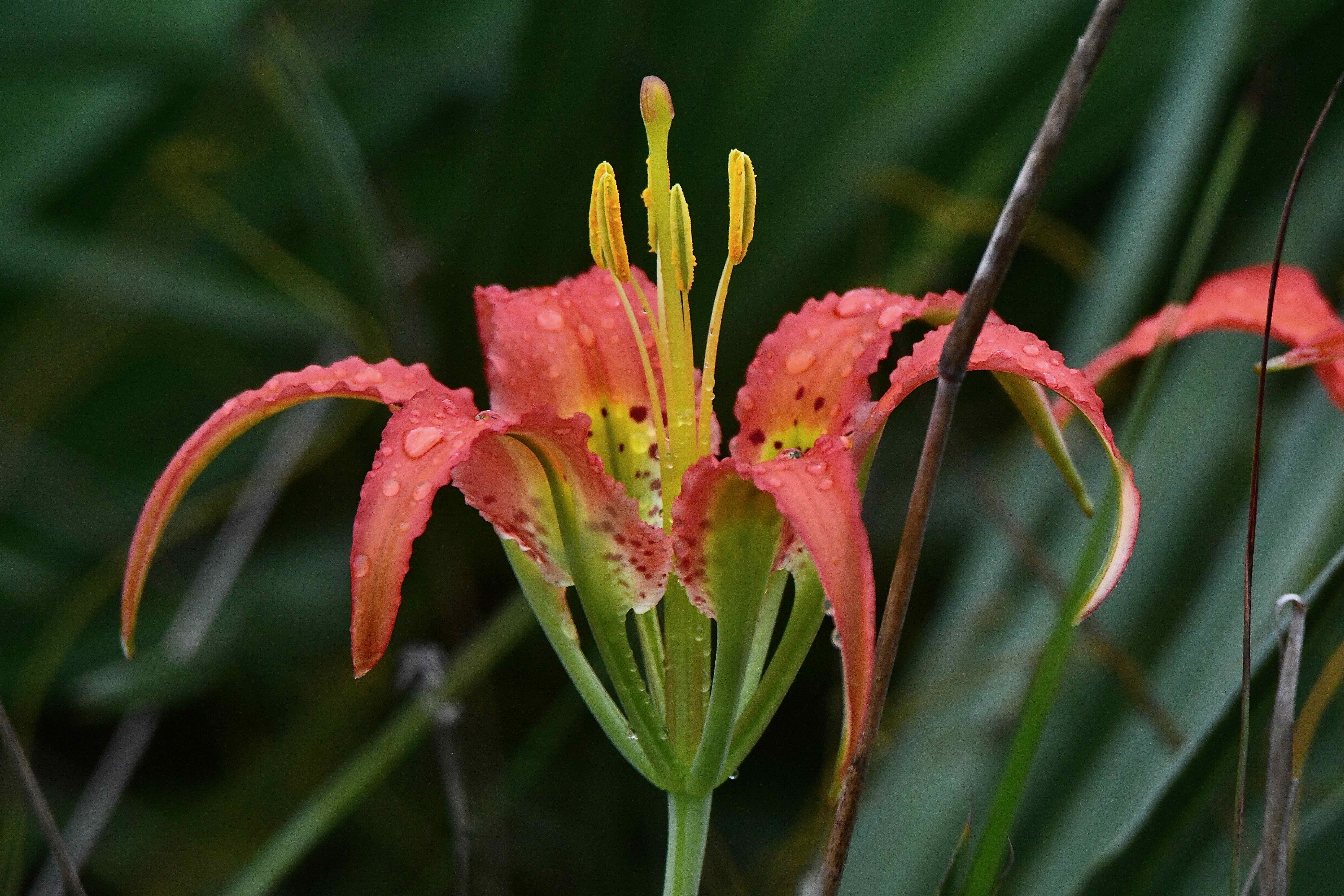
Catesby's lily, photographed at Jonathan Dickinson State Park, Hobe Sound, Martin County, in September 2025.
August is not exactly prime time in Florida. It’s hot. It’s humid. It’s hurricane season.
But it does offer one thing to look forward to: the blooms of Catesby’s lily, with their unmatched beauty, begin to make their annual appearance in open, wet habitats throughout the state. You’ve got to do a little hiking to spot one and maybe even get your feet wet in the process. But it’s well worth the effort if you do.
Catesby’s, Lilium catesbyi has the largest flower of any lily native to North America. It is ornate in its structure and lavishly hued, unlike any other flower we’ve seen in the wilds of Florida.
It’s also the only native lily growing in the wilds of South Florida, according the Delray Beach-based Institute for Regional Conservation.
Catesby’s can be found in just about every part of Florida, but nowhere is it commonly found. The IRC considers it imperiled within South Florida; the state officially lists it as threatened.
Beyond, Florida, Cateby’s lily’s native range extends southward along the Atlantic and Gulf coastal plains from Virginia south to Georgia and westward to Louisiana.
Its presence has been vouchered, or scientifically verified, in Collier, Lee, Martin and Palm Beach counties, but absent in Broward, Miami-Dade and Monroe. The IRC’s webpage for Catesby’s (link below) lists parks and preserves where it has been seen, though most are on the large size and a bit of legwork might be required to actually find the plants. Things do change, and there is always the possibility that Catesby’s is gone from a particular site or is no longer in bloom. Catesby’s also tends to be ephemeral, appearing one year but not the next.

Catesby’s is absolutely unmistakable when you first see it in the wild. It is two to three feet tall, emerging from a basal rosette of leaves. The stem is thin, almost flimsy looking, with maybe a few short and narrow leaves if it has any at all. According to the Flora of North America (link below), the stem on smaller plants can be too thin to bear the weight of the flower.
A single, large flower is borne atop the stem, bright red to orange with a yellow center. Filament-like yellow stamen stand above the center of the flower. What might appear to be six petals are actually brightly colored tepals — the outer part of a flower bud — that curve out and down.
There are tubes at the base of the tepal where nectar is produced. Nectar, of course, attracts insects, but most of Catesby’s visitors are small, too small, to contact both the anthers (male) and the stigma (female) parts of the flower in order to pollinate it. The palamedes swallowtail butterfly visits Catesby’s and has the size to do the job; the spicebush swallowtail is another large visitor, but even it might be too small to successfully pollinate the plant.
Like all lilies, Catesby’s emerges from an underground bulb. In the case of Catesby’s, the bulb is small; the FNA describes it as petite. The plant can remain dormant for years, keeping its powder dry so to speak until conditions are right for it to sprout and flower. It can appear in a certain spot one year, but not the next, then reappearing again. It is a fire-dependent plant, doing best when a blaze clears the understory from the flatwoods habitats where it grows. Fire suppression might be one reason for its rarity.
Catesby’s lily likes full sun but can tolerate a smidgeon of shade. It requires moist to wet soil but does not tolerate either flooding or drought. It has little tolerance for salt water or salt spray but can survive cold weather. It can be grown in a wildflower garden, but its need for wet soils limits where it can be used. It’s also a plant rarely seen for sale at commercial nurseries.
Favorite habitats include mesic (moderately wet) to wet flatwoods, wet prairies and savannas. It is a long-lived perennial.
So who is Catesby? Mark Catesby, an 18th century Englishman who explored the New World and studied its plants and animals. He was the author of Natural History of Carolina, Florida and the Bahama Islands, the first published account of North American flora and fauna. His work included water colors of various plants and animals and helped inspire American naturalists, including the noted Bartram family of Pennsylvania, to explore the natural world of the Southeast, including Florida.
Another of those American naturalists, Thomas Walter, was the first to scientifically describe Catesby’s, and named it after the Englishman in his honor.
Other common names include pine lily, tiger lily, leopard lily and southern red lily. It is a member of Liliaceae, the lily family.
Jonathan Dickinson State Park
Photo Gallery — Click on photo for larger image