
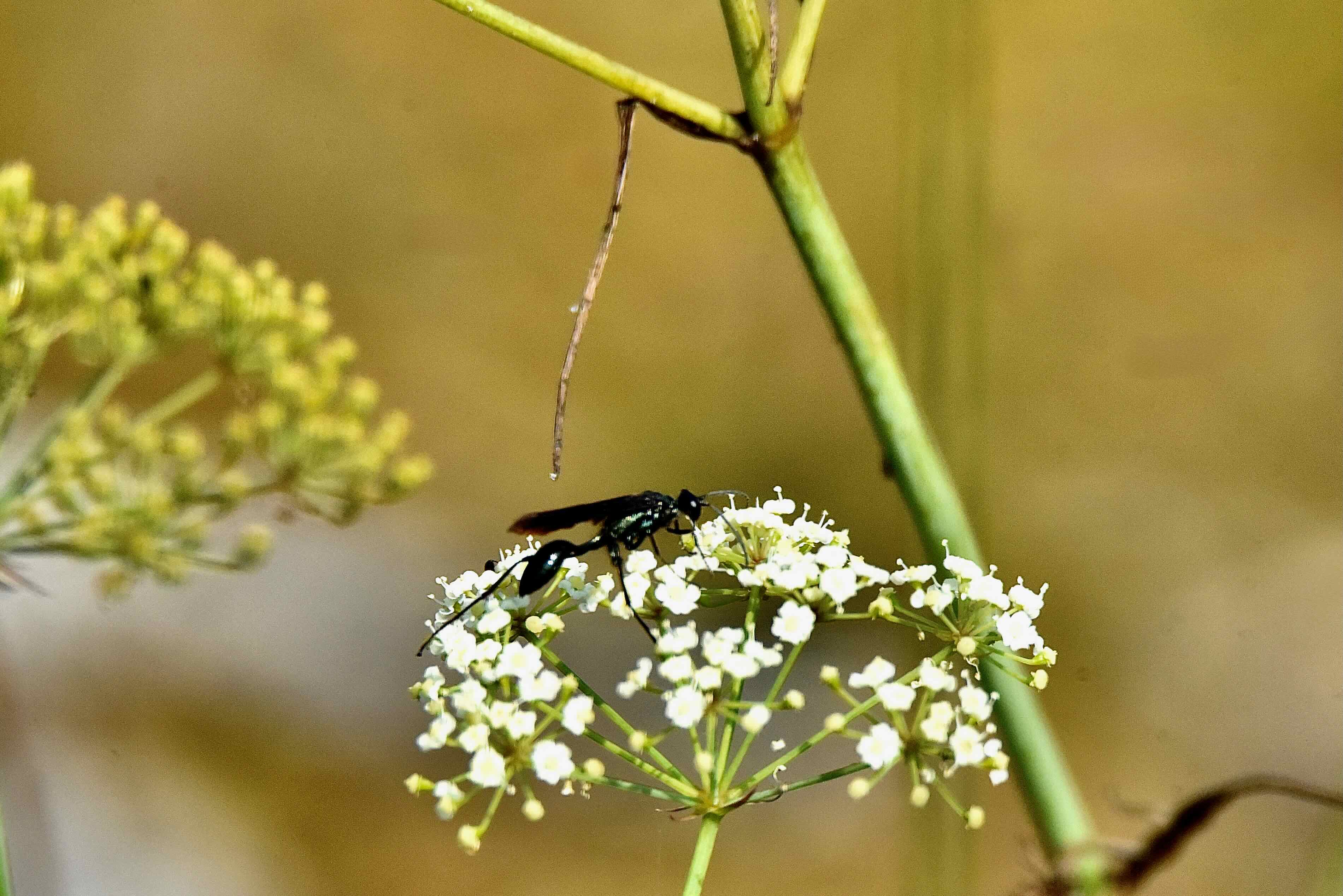
Blue mud dauber wasp, photographed at Shark Valley, Everglades National Park, Miami, Miami-Dade County, in May 2024.
Let’s just say the blue mud dauber wasp, Chalybion californicum has some rather unusual habits.
For one, spiders are its favorite food, particularly black widow spiders. For another, it’s a baby snatcher of sorts. It doesn’t build nests to house its offspring; rather, it uses the nests of one of its cousins. If the nest is empty, great. If it’s occupied, no problem. It just tosses the young occupant aside and makes itself at home.
And while blue mud daubers pose a mortal threat to certain arachnids, it’s mild-mannered otherwise. They are solitary wasps, but they will, on occasion, gather in numbers. Never fear. Leave them alone and they’ll reciprocate. They’re likely males and they don’t have stingers.
They are beautiful bugs, metallic blue and black, about an inch long and with the form of a typical wasp. One atypical characteristic: they have a long, narrow waist between their thorax and and abdomen. Combine these and blue mud daubers are relatively easy to identify.
Blue mud daubers are common insects found over most of the United States, south of the border into northern Mexico and north of the border into southern Canada.
Adult blue mud daubers feed on nectar and buzz from flower to flower as they sip up the sweet stuff. Their offspring are another matter altogether. Carnivores, and this is where their taste for spider comes in.
Females will hunt for a mud nest built by a black and yellow mud dauber, Sceliphron caementarium. If the nest is empty, she’ll go fetch some water and make whatever repairs are necessary to make the nest habitable. She’ll lay a single egg in the chamber and stock it with a paralyzed spider. When the egg hatches, the larvae will eat the unfortunate spider, spin a cocoon and pupate, eventually digging its way out of the nest and going about the business of an adult blue mud dauber.
If the nest has an occupant, mom blue mud dauber will remove both the egg/larvae and the spider/larder, replacing them both with her own.
Nesting sites include the hollows of plants or under the eaves of a building.
The blue mud dauber hunting technique is unusual as well. They’re able to land on a spider’s web without getting entangled. They’ll jiggle the strands mimicking prey. When the resident spider rushes to wrap up the seemingly hapless bug, the blue mud dauber stings and paralyzes it, making a high protein meal for its offspring.
Black widows are the preferred species. If they’re not plentiful, blue mud daubers will go after other web-spinning species.
Other names for our guy: blue dirt dauber and common blue mud wasp. Blue mud daubers are members of Sphecidae, the family of thread-waisted wasps.
Shark Valley — Everglades National Park